

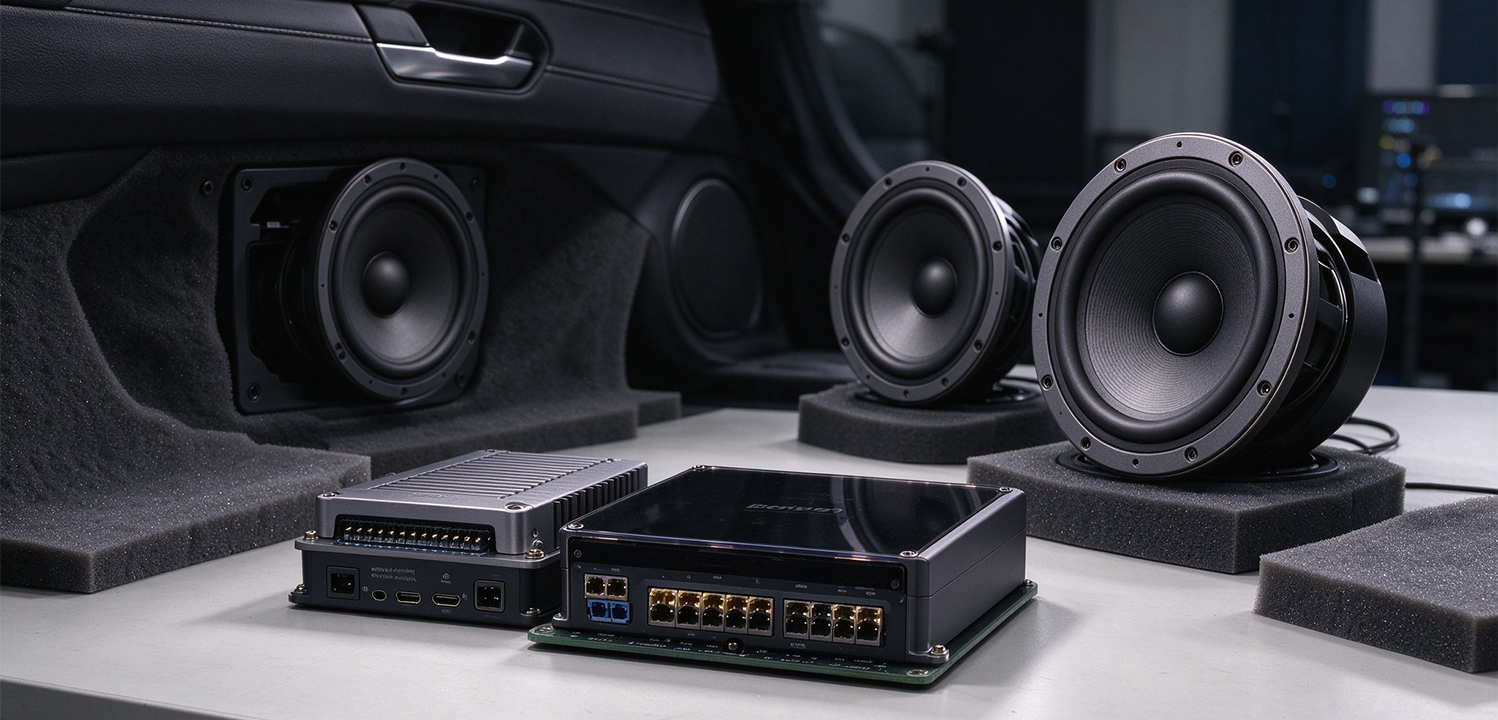
With the continuous improvement of consumers' requirements for in-vehicle travel experience, in-car audio system, as an important part of cockpit experience, has received more and more attention. In the past, high-quality in-car audio was only available in luxury brand high-end models, but now, with the maturity of digital signal processing (DSP) technology and the reduction of cost, more and more mid-range and even entry-level models have begun to be equipped with DSP power amplifier systems, bringing consumers a better in-car listening experience.
automotive DSP power amplifier is no longer a simple audio power amplification device, but an integrated acoustic system integrating digital signal processing, acoustic algorithm tuning, multi-channel power amplification and other functions. Through precise digital processing of audio signals, it can optimize the sound field in the car, compensate for the acoustic defects of the car interior space, and create a theater-level listening experience for drivers and passengers.
This article will comprehensively analyze the development status, technical core, market trends and application value of different vehicle segments of the global automotive DSP power amplifier industry, and deeply discuss the key factors that determine the sound quality of in-car audio systems, so as to provide professional reference for vehicle manufacturers, Tier 1 suppliers and industry practitioners.
The development of in-car audio systems has gone through a long evolutionary process. The earliest car audio was only a simple radio receiver, which could only listen to radio programs. Later, tape players, CD players, MP5 players and other playback devices were added, and the audio source was continuously enriched, but the core of the system was still the playback function.
For a long period of time, the audio power amplifier part of most models used analog power amplifier architecture, with simple structure and low cost, but limited ability to adjust sound effects. It could only simply adjust the volume and high and low tones, and could not carry out precise calibration and optimization of the sound field in the car. The sound quality was greatly affected by the structure of the car interior, speaker position and other factors, and it was difficult to achieve good sound field performance.
With the development of digital technology, digital signal processing technology began to be applied to the automotive audio field. DSP power amplifiers can perform complex digital operations on audio signals, including equalization, time delay, frequency division, phase adjustment, etc., which can accurately correct various acoustic problems in the car, so that the sound quality of in-car audio has been fundamentally improved.
In recent years, with the further reduction of DSP chip costs and the maturity of acoustic algorithm technology, DSP power amplifiers have gradually spread from high-end luxury cars to mid-range and even entry-level models, becoming an important selling point for more and more vehicle models to enhance their competitiveness.
The global automotive DSP power amplifier market has maintained a rapid growth trend in recent years. On the one hand, consumers' awareness and demand for in-car sound quality are constantly improving. More and more car buyers regard audio effect as an important reference indicator when choosing a car, which forces vehicle brands to continuously upgrade their audio configurations.
On the other hand, the continuous development of electric vehicles has also promoted the upgrading of in-car audio systems. Since electric vehicles have no engine noise, the interior environment is quieter, and the requirements for sound quality are correspondingly higher. At the same time, the quiet interior environment also makes the advantages of high-quality audio systems more obvious.
In addition, the rich in-car entertainment scenes also put forward higher requirements for audio systems. Whether it is listening to music, watching videos, making hands-free calls or even online karaoke in the car, they all need good audio support. The application of immersive audio technologies such as panoramic sound has further promoted the upgrading of in-car audio systems.
From the perspective of market segments, the demand for DSP power amplifiers in passenger cars is growing the fastest. With the upgrading of consumption, mid-range family cars have become the main force driving the growth of DSP power amplifier assembly rate. In the commercial vehicle sector, with the improvement of drivers' requirements for working environment, some high-end heavy trucks and pickup trucks have also begun to be equipped with better audio systems.
The reason why DSP power amplifiers can quickly replace traditional analog power amplifiers is that traditional in-car audio systems have many insurmountable acoustic pain points.
First, the interior space of the car is complex, and the acoustic environment is poor. The interior of the car is a closed and irregular small space, with a large number of sound-absorbing and reflective materials of different materials, and the installation position and angle of speakers are also limited by the vehicle structure, which is easy to cause problems such as uneven sound field, fuzzy sound positioning and unbalanced frequency response.
Second, the traditional analog power amplifier has limited adjustment capacity. It can only carry out simple high and low tone adjustment, and cannot carry out precise equalization correction for different frequency bands, nor can it adjust the time delay of each channel. The sound image position is often biased, and it is difficult to form a good sense of stage and space.
Third, the noise in the car has a great impact on the listening experience. During driving, various noises such as road noise, wind noise and tire noise will interfere with the audio, reducing the clarity and texture of the sound. Traditional audio systems do not have the ability to actively deal with noise.
The DSP power amplifier system can well solve the above problems through digital algorithm technology, which is also the fundamental reason why it is more and more widely used.
The core value of automotive DSP power amplifier lies in its ability to precisely optimize and adjust the audio signal through digital technology, so as to maximize the acoustic performance of the audio system in the limited space inside the car.
Equalization (EQ) is the most basic and core function of DSP power amplifiers. Through multi-section parametric equalizer, the gain of different frequency bands can be precisely adjusted to compensate for the frequency response deviation caused by speaker, vehicle structure, interior materials and other factors.
Different from the simple high, medium and low tone adjustment of traditional power amplifiers, DSP power amplifiers usually have 31-segment or even more fine equalization adjustment capabilities, which can carry out targeted compensation for each frequency point, so that the frequency response curve of the whole audio system is smoother and the sound is more natural and real.
For example, for the problem of insufficient low-frequency dive caused by the small volume of the car door speaker, the low-frequency gain can be appropriately increased through EQ; for the problem of harsh intermediate frequency caused by interior reflection, the corresponding frequency band can be attenuated to make the sound softer.
Another important function of DSP power amplifier is time delay adjustment. Since the distance from each speaker in the car to the driver's ear is different, the time when the sound reaches the ear is also different, which will lead to the deviation of sound image positioning and the confusion of sound field.
By setting independent time delay for each channel, the DSP power amplifier can make the sound of each speaker reach the listener's ear at the same time, so as to achieve accurate sound image positioning, make the sound field centered, and form a good sense of stage. For example, the singer's voice seems to come from the front center, and various instruments have their own positions, just like enjoying a live performance.
For different listening positions such as driver's seat, co-pilot's seat and rear row, different time delay schemes can also be set to ensure that each position can get a good listening effect.
In the traditional audio system, passive frequency divider is mostly used for frequency division of high, medium and low speakers. The passive frequency divider has large loss, low efficiency and fixed frequency division point, which is not flexible to adjust.
The DSP power amplifier can realize electronic frequency division through digital mode, set the frequency division point and slope of each channel flexibly, and distribute the power of each frequency band reasonably, so that each speaker can work in the best working frequency band, giving full play to its performance potential.
Electronic frequency division also avoids the power loss and signal distortion caused by passive frequency divider, improves the utilization rate of power, and makes the sound clearer and more powerful.
Phase problem is also an important factor affecting the sound quality of in-car audio. If the phases of different speakers are not aligned, it will cause mutual cancellation of sound waves, especially in the middle and low frequency bands, which will lead to weak low frequency and loose sound.
The DSP power amplifier can independently adjust the phase of each channel, realize the phase alignment of each speaker, avoid the cancellation of sound waves, make the low frequency more powerful and full, and the overall sound more cohesive and textured.
In addition, DSP power amplifiers also have various sound quality optimization algorithms, such as dynamic range compression, bass enhancement, treble extension, etc., which can further improve the listening experience according to different music styles and user preferences.
A high-quality automotive DSP audio system is not only a hardware power amplifier, but a systematic project covering acoustic design, algorithm research and development, system integration and professional tuning.
Before the product development, professional acoustic planning and design is the premise to ensure the final sound effect. According to the interior space structure of different models, the number and position of speakers, and the positioning of audio systems, professional acoustic designers should formulate targeted acoustic schemes, including speaker selection, layout scheme, power amplifier channel configuration, acoustic scheme design, etc.
A reasonable acoustic scheme can give full play to the performance of each component with limited cost and space, and achieve the best sound effect. On the contrary, if the scheme design is unreasonable, no matter how good the hardware is, it is difficult to achieve good sound quality.
For vehicle manufacturers, choosing a supplier with overall acoustic design capability can avoid the problem of mutual coordination between multiple suppliers, and get a complete set of audio solutions from scheme design to product landing.
The algorithm is the soul of DSP power amplifier. Excellent acoustic algorithm can make ordinary hardware configuration also emit amazing sound quality. The core algorithms include equalization algorithm, time delay algorithm, frequency division algorithm, noise suppression algorithm, active noise reduction algorithm, etc.
Some high-end algorithms, such as panoramic sound algorithm, spatial audio algorithm and headrest immersive audio algorithm, can bring a more shocking listening experience. For example, through the head-related transfer function (HRTF) algorithm, the sound can be virtualized in three-dimensional space, creating an immersive panoramic sound experience.
Enterprises with independent research and development capabilities of acoustic algorithms can continuously optimize and iterate the algorithms according to the characteristics of different models and user needs, and can also customize special sound effects for customers to form differentiated competitive advantages.
In the acoustic design stage, advanced speaker modeling and simulation technology can greatly improve the design efficiency and accuracy. Through professional acoustic simulation software, the magnetic circuit, vibration system and cavity of the speaker can be modeled and simulated, and the frequency response curve, sound pressure level, impedance characteristics and other parameters of the speaker can be calculated in advance.
Through simulation, potential problems can be found and optimized in the design stage, reducing the number of subsequent mold opening and commissioning, shortening the development cycle and reducing the development cost. At the same time, simulation technology can also help designers optimize the speaker structure and cavity design to maximize acoustic performance under limited volume.
Common simulation technologies include magnetic circuit system simulation, vibration system simulation, cavity thermal simulation, etc. Through multi-dimensional simulation calculation, the design scheme can be more accurate and reliable.
No matter how good the hardware and algorithm are, they need professional tuning to play their best effect. Automotive audio tuning is a work that combines technology and art. Tuners need to have rich acoustic experience and keen hearing, and adjust various parameters according to the acoustic characteristics of different models and the style orientation of brand sound.
Professional tuning tools are also essential. Self-developed tuning software can realize efficient and accurate tuning, support real-time adjustment and real-time monitoring, and greatly improve tuning efficiency and effect.
The tuning process usually includes speaker test, frequency response correction, time delay alignment, sound field debugging, style tuning and other links. After repeated debugging and listening verification, the final sound effect can reach the expected goal. High-level tuning teams can even create exclusive sound styles for different car brands, forming brand audio characteristics.
The channel number configuration of DSP power amplifier is one of the important indicators to measure the grade of audio system. From 4 channels to 16 channels, different channel numbers correspond to different vehicle positioning and audio system configurations.
4-6 channel DSP power amplifiers are mainly used in entry-level and mid-range models, which are the first choice for audio system upgrade of basic models. This configuration usually corresponds to the four-door speaker + tweeter scheme, which can realize independent adjustment of each speaker, significantly improve the sound field and sound quality, and the cost is relatively moderate.
For models originally equipped with ordinary analog power amplifiers, upgrading to 4-6 channel DSP power amplifiers is a cost-effective choice. With little increase in cost, the sound quality can be qualitatively improved, which is very suitable for mid-range family cars and commercial vehicle high-end models.
8-12 channel DSP power amplifiers are the mainstream configuration of medium and high-end models, which can support more complete speaker systems, including tweeters, mid-range speakers, woofers, surround speakers and even subwoofers.
With more channels, it can more accurately build a three-dimensional sound field, achieve surround sound effect, and bring a better sense of immersion. At the same time, it can support more advanced sound effects such as panoramic sound and spatial audio, which is suitable for models that pursue high-quality audio experience.
At present, more and more mid-to-high-end passenger cars and new energy models adopt 8-12 channel DSP power amplifier solutions, which have become an important configuration to reflect the grade of models.
16-channel and above DSP power amplifiers are the flagship configuration, mainly used in luxury brand high-end models and high-end modified audio systems. With super multi-channel support, it can build a very complete three-dimensional panoramic sound system, including sky speakers, headrest speakers and other configurations, bringing theater-level immersive listening experience.
This configuration is usually matched with high-end audio brands and professional tuning, and the sound effect reaches the top level of vehicle-mounted audio. However, due to the high cost, it is mainly concentrated in luxury models at this stage, and with the reduction of cost, it will gradually sink to mid-to-high-end models in the future.
Excellent DSP power amplifier platforms usually adopt modular design, which can flexibly configure different channel numbers and function modules according to customer needs. The same core DSP platform can derive products of 4 channels, 6 channels, 8 channels, 12 channels and other specifications through different power amplifier module combinations, so as to adapt to different models and configuration requirements.
This design can not only meet the needs of different customers, but also realize the scale effect of core components, reduce product costs, and shorten the development cycle of new products.
In the past, many high-end audio technologies could only be experienced on luxury brand models, but now with the maturity of technology and the reduction of cost, more and more high-end audio technologies have begun to be applied to mass-market models.
Immersive panoramic sound technology can create a three-dimensional sound field effect, making the sound come from all directions, including the top of the head, with a strong sense of immersion and presence. In the past, this technology was only equipped on top luxury cars, but now more and more mid-range models have begun to support panoramic sound effects through DSP algorithm optimization.
Through the algorithm optimization of DSP power amplifier, combined with a reasonable speaker layout, a good panoramic sound effect can be achieved with a limited number of speakers, so that ordinary models can also experience the shocking feeling of immersive audio.
Active Noise Cancellation (ANC) technology can generate reverse sound waves through the audio system to offset the noise in the car, so as to reduce the noise level in the car and improve the quietness of the car. This technology was first used in high-end luxury cars, and now it has gradually begun to spread to mid-range models.
The vehicle-mounted active noise reduction system is usually combined with the DSP power amplifier system. Through the microphone in the car, the noise signal is collected in real time, and after calculation and processing by the DSP chip, the reverse phase sound wave is output through the speaker to cancel the noise.
Active noise reduction can significantly reduce low-frequency noise such as road noise and tire noise during driving, improve the comfort of the ride, and also create a better listening environment for the audio system.
Headrest audio technology is to install speakers in the headrest of the seat, so that the sound is close to the ear, creating a personalized listening area. With the support of DSP algorithm, it can realize immersive panoramic sound effect at the head position, and can also realize independent listening of different seats without interfering with each other.
For example, the driver listens to navigation prompts, while the co-pilot listens to music, which do not interfere with each other. This personalized audio experience was only available in very high-end models before, but now it is gradually being popularized through the optimization of DSP technology.
With the development of intelligent cockpit, audio system is no longer independent, but deeply integrated with cockpit atmosphere lights, scenes and other systems. Through the sound-light linkage algorithm, the atmosphere lights can change synchronously with the rhythm and style of music, creating a more immersive in-car atmosphere.
At the same time, the audio system can also automatically switch different sound effect modes according to different driving scenes, such as dynamic mode during sports driving, comfortable mode during cruising, etc., to bring a more appropriate audio experience.
As an automotive electronic product, DSP power amplifier must first meet the requirements of vehicle-grade reliability, and can operate stably for a long time in the harsh automotive environment.
The automotive industry has strict standards for electronic components. Components used in automotive products usually need to meet the AEC-Q200 standard, which is a reliability standard for automotive electronic components formulated by the Automotive Electronics Council.
Components that have passed the AEC-Q200 certification have undergone strict reliability tests such as high temperature, low temperature, humidity and impact, and can adapt to the harsh working environment of automobiles. Using vehicle-grade components is the basis for ensuring the long-term stable operation of DSP power amplifiers.
High-quality DSP power amplifier products will insist on using vehicle-grade components in key components, even if the cost is higher, but it can ensure the reliability and service life of the products.
The temperature environment in the car changes greatly. In summer, the temperature inside the car under direct sunlight may exceed 80 degrees Celsius, and in winter in cold areas, the temperature may be as low as minus 40 degrees Celsius. DSP power amplifiers, as electronic products installed in the car, must be able to work normally in such a wide temperature range.
Therefore, in the product design stage, it is necessary to fully consider the heat dissipation design and low-temperature start-up performance of the product, and select components with wide temperature range specifications. At the same time, strict high and low temperature tests and temperature shock tests are required to verify the reliability of the product under extreme temperature conditions.
There are a lot of electronic devices in the car, and the electromagnetic environment is complex. DSP power amplifiers, as high-power electronic devices, must have good electromagnetic compatibility on the one hand, and will not produce excessive electromagnetic interference to affect the normal operation of other on-board devices; on the other hand, they must have strong anti-interference ability and can work normally in the complex electromagnetic environment of the car.
Automotive EMC tests include conducted emission, radiated emission, electrostatic discharge, electrical fast transient burst, surge and other items. Only products that meet the corresponding standards can be used in vehicles.
During the driving process of the car, there will be continuous vibration, and in some special cases, there will be strong impact. DSP power amplifier products need to have sufficient mechanical strength and structural reliability to withstand long-term vibration and certain impact without damage or performance degradation.
Therefore, the structural design of the product needs to be fully reinforced, and the fixation of internal components and circuit boards should be firm. At the same time, strict vibration test and drop test are required to verify the mechanical reliability of the product.
In the automotive audio industry, the competition is no longer limited to a single hardware product, but the competition of full-stack acoustic capability. Suppliers with full-stack capability from acoustic design, algorithm research and development, product manufacturing to professional tuning can provide customers with more valuable services.
For vehicle manufacturers, if the acoustic scheme design, DSP power amplifier hardware, speaker matching and tuning are completed by different suppliers, it will bring a lot of communication and coordination work, and it is easy to have problems such as unclear responsibility and mutual buck-passing when problems occur.
Suppliers with full-stack acoustic capability can provide one-stop overall solutions, from initial scheme design, product development to later tuning and after-sales service, all completed by one supplier, which greatly reduces the communication cost and coordination cost of customers, and improves project efficiency.
The sound quality of the audio system is determined by the weakest link in the whole system. Only by optimizing the whole system can we achieve the best effect. Suppliers with full-stack capability can consider and optimize the whole system from the perspective of system engineering, instead of only focusing on their own parts.
From speaker selection, cavity design to DSP algorithm and tuning, each link can be coordinated and matched with each other to give full play to the performance of each component and achieve the best overall sound effect.
Different vehicle brands have different understandings and positioning of sound quality, and some brands prefer heavy low-frequency dynamic sense, while others prefer delicate and analytical sound quality. Suppliers with independent algorithm and tuning capabilities can carry out targeted customized tuning according to the brand style of customers, creating exclusive sound characteristics for customers.
In addition, for some special functional requirements, such as special sound effects, scene audio, etc., full-stack suppliers can also quickly realize customized development, helping customers build differentiated competitive advantages.
Looking forward to the future, automotive DSP audio technology will continue to develop in the direction of higher intelligence, better sound quality and more scenarios, bringing consumers a better in-car audio experience.
Artificial intelligence technology will be more and more applied to automotive audio systems. In the future, audio systems will be able to automatically identify the type of music being played, and automatically switch the appropriate sound effect mode and equalization parameters. At the same time, they can also automatically adjust the sound effect according to the noise level, speed and other environmental conditions in the car, so as to maintain the best listening experience at all times.
In addition, AI can also learn the listening preferences of different users and automatically adjust to the sound style that users like. Each driver can have his own exclusive sound effect scheme, which can be automatically identified and switched when getting on the car.
Spatial audio technology will further penetrate into the automotive audio field. With the continuous upgrading of DSP computing power and algorithm, more realistic three-dimensional sound field effects can be achieved, and the sound has a clear sense of height, depth and orientation, bringing an immersive listening experience like being in a concert hall or cinema.
At the same time, with the popularization of in-car video entertainment, the demand for audio-visual integrated experience is also increasing. Spatial audio matching video content will become an important selling point of in-car entertainment systems.
In the future, DSP audio systems will be more deeply integrated with the entire cockpit domain system, rather than independent modules. Through the cockpit domain controller, audio, video, interface, control and other systems are unified and coordinated to achieve a more intelligent and seamless interactive experience.
For example, when the navigation prompt sounds, the music volume will be automatically reduced; when the voice call is connected, the audio system will automatically switch to the call mode. These linkage functions require the in-depth integration of audio systems and other cockpit systems.
Personalized and zoned audio will become an important development direction. Through precise sound field control and array speaker technology, independent audio zones can be formed in different positions of the car. People in different seats can listen to different audio content without interfering with each other, which can not only meet the personalized needs of different passengers, but also avoid the problem that navigation and other prompts affect other passengers.
The global automotive DSP power amplifier market is in a period of rapid development. Consumers' increasing demand for in-car sound quality and the continuous upgrading of automotive intelligent cockpits have jointly promoted the popularization and development of DSP audio technology.
From entry-level models to luxury flagship models, from basic sound quality optimization to immersive panoramic sound experience, DSP power amplifier technology is playing an increasingly important role in the automotive audio field. For vehicle manufacturers and Tier 1 suppliers, choosing a supplier with full-stack acoustic capabilities, independent algorithm research and development capabilities, professional tuning teams and strict vehicle-grade quality control can not only improve the audio performance of products, but also create differentiated selling points for models and enhance market competitiveness.
In the future, with the continuous integration of AI, spatial audio, active noise reduction and other technologies, automotive DSP audio systems will become more intelligent and high-quality, bringing people a better in-car travel experience, and also bringing broader development space for the entire industry.

This website uses cookies to ensure you get the best experience on our website.


 WhatsApp
 Phone
 E-mail
 Message
Comment
(0)