

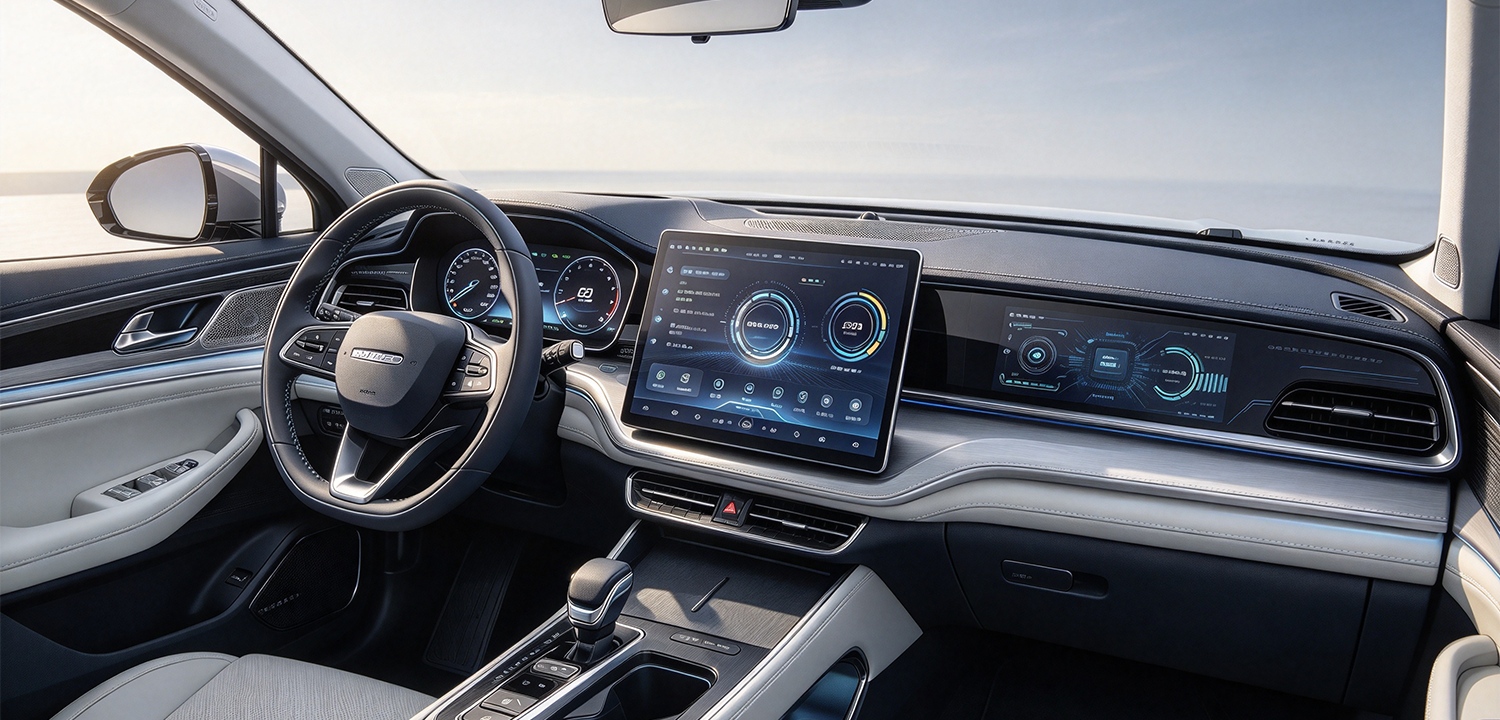
The global automotive industry is undergoing an unprecedented digital transformation, and the cockpit, as the core interactive space between drivers, passengers and vehicles, has become one of the fastest-growing segments of automotive electronics. As vehicle electrification and intelligent connectivity accelerate, both passenger car and commercial vehicle OEMs, as well as Tier 1 component suppliers, are facing dual pressures: to deliver increasingly rich intelligent interactive experiences, and to control development costs, shorten project cycles and ensure long-term reliability of vehicle-grade products.
Against this backdrop, modular display audio and infotainment solutions have emerged as the optimal path for the majority of global vehicle brands to achieve cockpit intelligent upgrade at a controllable cost. From entry-level compact cars to light trucks and pickup trucks, from basic radio systems to full-featured smart cockpits with multi-screen interaction and voice control, the demand for flexible, customizable and mass-producible cockpit electronic solutions continues to rise in emerging markets such as Southeast Asia, South America, the Middle East and India, as well as in mature markets.
This article will provide an in-depth analysis of the development status, core technology trends, market demand characteristics of different vehicle segments, and the value of modular platform architecture for the global smart cockpit industry in 2026 and beyond. It will also sort out the key factors that OEMs and Tier 1 suppliers should focus on when selecting cockpit electronic solution partners, so as to provide decision-making reference for industry practitioners.
In recent years, the global automotive cockpit electronics market has maintained a steady growth trend even amid fluctuations in overall vehicle sales. Driven by factors such as the popularization of intelligent connected vehicles, the continuous decline in the cost of chip and display technologies, and consumers' increasing demand for in-vehicle experience, the penetration rate of intelligent infotainment systems, digital instrument clusters and multi-screen interactive systems has increased year by year.
For a long time in the past, high-end smart cockpit configurations were mainly concentrated in high-end models of luxury brands, and most mid-to-low-end models could only be equipped with basic radio or simple MP5 systems. However, with the maturity of chip platforms and the formation of scale effects of supply chains, more and more vehicle brands have begun to lower the configuration of intelligent cockpits to entry-level and mid-range models, which has greatly expanded the market capacity of the entire industry.
In the commercial vehicle sector, the demand for cockpit electronics upgrade is also growing. With the development of logistics intelligence and the improvement of drivers' requirements for working environment, more and more light trucks, heavy trucks and pickup truck models have begun to replace the original simple mechanical instruments and radio systems with display audio systems with navigation, Bluetooth calling and rear-view camera functions. The particularity of commercial vehicle operating conditions also puts forward higher requirements for the stability, durability and environmental adaptability of cockpit electronic products.
From a global perspective, the demand characteristics of cockpit electronics products vary significantly across different regional markets, which is closely related to factors such as local automobile industry development level, consumption capacity, regulatory requirements and user habits.
In mature markets such as Europe and North America, users have higher requirements for intelligent functions, audio-visual experience and system fluency of cockpit products, and have strict regulatory requirements for product safety, electromagnetic compatibility and data privacy. High-end models are equipped with domain controller-level smart cockpit solutions, while mid-to-low-end models also generally support smartphone interconnection functions such as CarPlay and Android Auto.
In emerging markets represented by Southeast Asia, South America, the Middle East and India, cost performance is the primary consideration for most vehicle brands. On the premise of ensuring vehicle-grade quality and basic functions, they pursue the best balance between function, configuration and price. The demand for display audio products with complete basic functions, stable performance and moderate price is the strongest. At the same time, with the continuous popularization of smart phones, the support for smartphone interconnection functions has gradually become a standard configuration for entry-level models in these markets.
In the Chinese market, the intelligentization of cockpits is developing most rapidly. Various new functions such as large screens, multi-screen interaction, voice control and on-board entertainment emerge in endlessly. However, for vehicle brands focusing on overseas markets, it is more important to select a mature and stable general solution that can adapt to the needs of different regional markets, rather than blindly pursuing the most cutting-edge and complex functions.
Facing the rapidly changing market demand and increasingly fierce industry competition, global OEMs and Tier 1 suppliers are facing multiple challenges in the development and production of cockpit electronic products.
First of all, the project development cycle is compressed. In the past, the development cycle of a vehicle model usually lasted for 3-5 years, but now under the background of rapid iteration of intelligent functions, the update speed of vehicle models is significantly accelerated, and the R&D cycle of cockpit electronics, as an important part of the vehicle's intelligent experience, is also continuously compressed. How to complete the customized development of products in a shorter time and achieve mass production smoothly has become a major test for suppliers.
Secondly, cost control pressure is increasing. The price competition in the global automobile market is becoming increasingly fierce, especially in the mid-to-low-end market segment. Vehicle brands are very sensitive to the cost of parts and components. While requiring continuous improvement of product functions and performance, they also require continuous reduction of procurement costs. This requires solution providers to achieve cost optimization through platform-based design, modular multiplexing and large-scale manufacturing.
Thirdly, vehicle-grade quality and reliability requirements are strict. Unlike consumer electronics, automotive electronic products need to operate stably for a long time in harsh environments such as high temperature, low temperature, humidity, vibration and electromagnetic interference. Any quality problem may lead to vehicle recall, which will bring huge economic losses and reputation damage to vehicle enterprises. Therefore, perfect quality management system and sufficient reliability verification capability are the basic thresholds for entering the automotive front-loading market.
Finally, the diversity of demand brings customization pressure. Different vehicle brands, different models and even different configurations of the same model have different requirements for product appearance size, function configuration, software interface and system parameters. If a set of solutions is developed separately for each project, it will inevitably lead to a sharp rise in R&D costs and a prolonged cycle. How to achieve rapid customization based on a unified platform has become the core competitiveness of cockpit electronic solution providers.
A high-quality display audio system is no longer just a simple radio or music player, but the core control center of the entire cockpit entertainment, information and vehicle interaction. For global vehicle brands, a qualified vehicle-grade display audio platform needs to meet the following core requirements.
The size of the on-board display screen is one of the most intuitive differences between different vehicle models and configurations. From 7-inch basic models to 10.1-inch mainstream models, and then to 12.3-inch and even 15.6-inch large-screen high-end models, different sizes correspond to different vehicle positioning and user groups.
For entry-level models and commercial vehicles, 7-inch and 8-inch display screens are the mainstream choice, which can meet the basic functions of navigation, reversing image and Bluetooth call while controlling costs. For mainstream passenger cars, 9-inch and 10.1-inch screens have become the standard configuration, which can bring better visual experience and interactive experience. For medium and high-end models, 12.3-inch and larger screens are gradually becoming popular, supporting higher resolution and more complex interface display.
A mature solution provider should have a full-size product matrix covering 7 inches to 15.6 inches, and adopt a modular design with the same core platform and different structural appearances, so as to help customers quickly match screens of corresponding sizes according to different model positioning, and avoid repeated development of underlying hardware and software.
At present, the mainstream vehicle display audio systems in the market mainly adopt three operating systems: Linux, Android and other real-time operating systems, each of which has its own applicable scenarios and advantages.
Linux system is famous for its high stability, fast startup speed and low resource occupation. It is very suitable for commercial vehicles and entry-level passenger car models that focus on functional stability. The system has simple structure, strong reliability and low failure rate, and can operate stably for a long time in complex working conditions. At the same time, the development cost of Linux system is relatively low, which can help customers control the overall product cost.
Android system has rich ecological resources, strong scalability and better human-computer interaction experience, and is suitable for mid-to-high-end models that pursue rich functions and intelligent experience. It can install various on-board applications, support voice interaction, on-board navigation, online entertainment and other functions, and can bring users an experience close to that of smart phones.
In addition, there are some dedicated real-time operating systems for specific functional products such as radio and instrument, which have higher real-time performance and lower cost.
Excellent display audio platforms should be able to support multiple operating systems on the same hardware architecture or similar platform architectures, and provide corresponding system solutions according to the different positioning and functional requirements of customers' models, so as to achieve the best match between cost and performance.
A complete display audio system needs to integrate a variety of functions to meet the diverse needs of users in the driving process. The basic functions include radio, Bluetooth call, Bluetooth music, USB/SD media playback, rear view camera (RVC), GPS navigation, etc. The extended functions include 360-degree panoramic view (AVM), driver monitoring system (DMS), occupant monitoring system (OMS), AR navigation, vehicle networking, T-BOX integration, etc.
For vehicle enterprises, the scalability of the platform is very important. They hope that the same basic platform can derive products with different configurations by adding or reducing functional modules, so as to cover different configuration levels of the same vehicle model and reduce the overall development cost. For example, the low-configuration version only has basic radio, Bluetooth and reversing image functions, while the high-configuration version adds navigation, 360 panoramic view, mobile phone interconnection and other functions on the same platform.
In addition, with the development of vehicle networking, 4G/5G network support has gradually become an important configuration of many models. The platform should reserve corresponding interfaces and expansion capabilities to facilitate the subsequent integration of networking functions and OTA upgrade functions.
In the global market, especially in overseas markets, the support for smartphone interconnection functions such as CarPlay and Android Auto has become one of the most concerned functions of consumers when buying cars, and even a rigid demand for many models to enter overseas markets.
Wired and wireless smartphone interconnection can seamlessly connect users' mobile phones with the vehicle's central control screen, and map the navigation, music, phone and other applications on the mobile phone to the vehicle screen, which not only improves the convenience of use, but also ensures the safety of driving operation.
However, the certification of smartphone interconnection functions is complicated and the cycle is long, which is a big problem for many vehicle enterprises and solution providers. A solution provider with mature technology and rich certification experience can greatly shorten the certification cycle, save certification costs, and help customers' products pass relevant certifications smoothly and quickly enter the target market.
In addition to the two mainstream interconnection protocols, some regional markets also have demand for other interconnection methods such as domestic interconnection protocols and screen projection protocols. A platform with strong compatibility can better adapt to the needs of different markets.
Different from consumer display screens, vehicle display screens need to maintain good display effect in various complex environments. On the one hand, they need to have high brightness and wide viewing angle, ensuring that the screen content is clearly visible under strong direct sunlight; on the other hand, they need to have anti-glare and anti-reflection treatment to avoid glare interference to drivers.
High-quality IPS display screens have become the mainstream choice of vehicle display screens because of their wide viewing angle, true color reproduction and good display effect. In addition, the display screen also needs to adapt to a wide temperature range, from low temperature of minus tens of degrees to high temperature of tens of degrees above zero, and can work normally without problems such as color deviation, response slowdown or failure to light up.
In terms of touch, capacitive touch screen has become the mainstream configuration because of its good touch experience and support for multi-touch. It needs to ensure accurate and sensitive response during driving, and can also operate normally in scenarios such as wet hands and wearing gloves in some models.
Facing the dual pressures of diversified demand and cost control, more and more industry participants have realized that adopting a unified modular platform architecture is the fundamental way to solve the contradiction between personalized customization and large-scale production.
The so-called modular platform architecture is to abstract and stratify the entire product system, divide it into multiple relatively independent functional modules such as core motherboard, power supply module, display module, interface module and software system, and design and verify each module uniformly. When facing different customer needs, it is only necessary to select and combine corresponding modules and carry out targeted adaptive adjustment of appearance structure and software interface, so as to quickly form a product solution that meets customer needs.
The core of the platform lies in the reuse of underlying hardware and basic software. The core chip, main circuit, basic driver and system bottom layer are all verified by long-term mass production, with high maturity and stability. The differences between different projects are mainly concentrated in the appearance structure, screen size, function clipping and upper software interface, which greatly reduces the workload of new project development.
Compared with the traditional one-to-one independent development mode, the modular platform-based development mode has significant advantages in the following aspects.
First, it shortens the project development cycle significantly. Since most of the underlying hardware and basic software have been maturely verified, the new project only needs to carry out appearance structure design, interface adaptation and software interface customization, which can shorten the entire development cycle from the original 12-18 months to 3-6 months, greatly accelerating the product launch speed and helping customers seize the market opportunity.
Second, it reduces R&D costs and procurement costs. Platform-based multiplexing avoids repeated development of the same underlying technology, and 摊薄了研发成本. At the same time, the unified procurement of core components can form a scale effect, reduce the procurement cost of a single product, and ultimately pass on the cost advantage to customers.
Third, it improves product quality and stability. The core platform has passed the verification of multiple mass production projects and long-term market inspection, and various potential problems have been fully exposed and solved. The product maturity and reliability are much higher than newly developed solutions, which can greatly reduce the quality risk in the mass production stage.
Fourth, it facilitates subsequent maintenance and iteration. Products based on the same platform have unified maintenance systems and technical support systems, which can share the results of subsequent system optimization and function iteration, and continuously improve product experience through OTA and other methods.
An advanced cockpit electronic platform can not only derive display audio products of different sizes and configurations, but also cover a variety of cockpit electronic products such as digital instruments, co-pilot displays and rear-seat entertainment displays, forming a "one platform for multiple products" product architecture.
Through the unified central control unit and software platform, multiple screens in the cockpit can be connected to realize multi-screen interaction, information sharing and collaborative work. For example, the navigation information on the central control screen can be projected onto the instrument screen, and the rear-seat entertainment screen can share the audio and video resources of the whole vehicle.
This architecture not only improves the intelligent experience of the whole cockpit, but also reduces the overall system cost, avoids repeated configuration of multiple sets of chips and systems, and is an important development direction of the future intelligent cockpit.
Different from passenger cars, commercial vehicles including light trucks, heavy trucks and pickup trucks have very different use scenarios and user requirements for cockpit electronic products, and also put forward more targeted requirements for product performance.
Commercial vehicles usually operate for a long time, and the driving environment is complex and changeable. They may face various harsh conditions such as high temperature in summer, severe cold in winter, bumpy roads, dusty environment and long-term continuous operation. This requires cockpit electronic products to have extremely high reliability and environmental adaptability.
In terms of temperature resistance, commercial vehicle products need to adapt to a wider operating temperature range, ensuring normal operation from minus 40 degrees Celsius to high temperature above 85 degrees Celsius. In terms of vibration resistance, they need to pass strict vibration tests to ensure that they will not have problems such as loose parts and poor contact during long-term bumpy driving. In terms of protection, they need to have a certain ability of dustproof and anti-interference to adapt to the complex working environment.
For this reason, many commercial vehicle models choose Linux system as the operating system of display audio. The system has simple structure, stable operation, low failure rate and fast startup speed, which is very suitable for commercial vehicles that pay attention to practical functions and stable operation.
The users of commercial vehicles are mostly professional drivers, and their demand for cockpit electronic products is more focused on practicality, rather than the fancy entertainment functions of passenger cars. The most concerned functions include navigation, Bluetooth call, reversing image, music playback and radio.
Clear and easy-to-operate interface is also very important. Drivers need to complete the operation quickly during driving intervals, and the interface that is too complicated will increase the operation risk. Therefore, the interface design of commercial vehicle display audio products usually tends to be simple and clear, with large buttons and clear levels, which is convenient for drivers to operate quickly.
In addition, for some special commercial vehicle models, there are also targeted functional requirements, such as supporting the access of various vehicle sensors, displaying vehicle operating data, and connecting with the fleet management system.
The commercial vehicle market is very sensitive to product price, and cost control is a key factor that customers pay attention to. On the premise of ensuring quality and basic functions, pursuing the highest cost performance is the demand of most commercial vehicle brands.
At the same time, commercial vehicles have a long service life and high utilization rate, so the after-sales service and long-term technical support for products are also very important. Solution providers need to be able to provide stable spare parts supply and technical support for a long time to ensure that products can get timely maintenance and upgrade during the entire service life.
In the passenger car sector, with the continuous popularization of intelligent technology, consumers' expectations for cockpit experience are increasing day by day. How to achieve a balance between intelligent experience and cost control is the core issue that major vehicle brands need to solve.
In the past, intelligent cockpit configurations were mostly concentrated in high-end models, but now more and more mid-to-low-end models have begun to be equipped with intelligent display audio systems, and the configuration has been continuously improved.
For entry-level compact cars, the basic configuration of 7-9 inch screen + Bluetooth + radio + reversing image + smartphone interconnection has gradually become the mainstream. This configuration can meet the daily needs of most users, and the cost is relatively controllable, which is very popular in emerging markets.
For mainstream family cars, 10.1-12.3 inch large screens + Android system + navigation + voice control + smartphone interconnection have gradually become standard. Some models will also add 360-degree panoramic images, driving assistance display and other functions to further enhance the product competitiveness.
For medium and high-end passenger cars, multi-screen interaction and intelligent interaction have become important directions for cockpit upgrade. The central control screen, digital instrument, co-pilot display and even rear-seat entertainment screen form a multi-screen interactive system, which can realize information sharing and linkage control.
Intelligent voice interaction is also more and more widely used. Drivers can control the vehicle's entertainment, navigation, air conditioning and other functions through voice, reducing hand operation during driving and improving driving safety. In addition, gesture recognition, face recognition and other interactive methods are also gradually applied to high-end models.
For vehicle brands, they do not need to develop all these functions from scratch. They can realize the upgrade from basic configuration to high-end configuration by selecting a platform with strong scalability and adding corresponding functional modules, which greatly saves development costs and cycles.
Different vehicle brands have different brand tonality and design languages, and they also have different requirements for the UI interface of the cockpit system. A mature solution provider should have professional HMI design capabilities, which can carry out personalized interface customization according to the brand style and design needs of different customers, and create an exclusive cockpit interactive experience for customers.
From the overall visual style, icon design, to the menu structure and interactive logic, all can be customized in depth. At the same time, it supports multiple theme switching, boot animation customization and other personalized settings to meet the differentiated needs of different brands and different models.
For automotive electronic products, quality is always the first priority. A perfect quality management system and sufficient testing and verification capabilities are the basic guarantee for the stable operation of products in the whole life cycle.
IATF 16949 is the international standard for automotive quality management systems, and it is also the basic threshold for enterprises to enter the automotive front-loading supporting market. This standard puts forward strict requirements for the entire process of product design and development, production and manufacturing, supplier management, quality control and after-sales service.
Enterprises that have passed the IATF 16949 certification have a standardized quality management system, which can ensure that the entire process from product development to mass production is carried out in accordance with strict quality specifications, so as to continuously and stably produce products that meet customer requirements and regulatory requirements.
In addition to IATF 16949, there are also ISO 9001 quality management system, ISO 14001 environmental management system, ISO 45001 occupational health and safety management system and other system certifications, which together constitute the comprehensive management system of enterprises.
In the actual quality management process, advanced quality tools such as APQP (Advanced Product Quality Planning), PPAP (Production Part Approval Process), FMEA (Failure Mode and Effects Analysis), SPC (Statistical Process Control) and MSA (Measurement System Analysis) need to be used to carry out all-round quality control over the entire product life cycle.
In the product design stage, through FMEA analysis, potential failure modes and risks are identified in advance, and corresponding improvement measures are formulated to avoid problems in the design stage as much as possible. In the production preparation stage, through APQP planning, all links of production are reasonably arranged to ensure that the production process is stable and controllable. Before mass production, PPAP submission and approval are required to ensure that all aspects of products and processes meet customer requirements.
In the production process, a three-level inspection system of IQC (incoming quality control), IPQC (in-process quality control) and OQC (outgoing quality control) is implemented to strictly control the quality of incoming materials, production process and finished products. At the same time, quality data are statistically analyzed through SPC to find abnormal trends in the production process in time and take corrective measures.
Before mass production, automotive electronic products need to undergo a series of strict reliability tests to verify whether the products can operate stably in various harsh environments.
Environmental reliability tests include high and low temperature test, temperature shock test, humidity and heat test, salt spray test, dust test, waterproof test, etc., which are used to verify the adaptability of products to various climatic environments.
Mechanical reliability tests include vibration test, drop test, plug-in force test, key life test, touch screen life test, etc., which are used to verify the mechanical structure strength and service life of products.
Electrical performance tests include EMC electromagnetic compatibility test, electrostatic test, automotive pulse interference simulation test, etc., which are used to verify the anti-interference ability and electromagnetic emission level of products in the vehicle electrical environment.
In addition, there are long-term aging test, optical performance test, audio performance test and other special test items. Only products that have passed all the tests can be put into mass production, so as to ensure that the products delivered to customers have reliable quality.
Excellent product design and quality management ultimately need to be implemented through strong manufacturing capabilities. For automotive electronic products, large-scale, high-precision and highly automated production capacity is the key to ensuring stable delivery and consistent product quality.
Surface Mount Technology (SMT) is the core link of automotive electronic product manufacturing. The quality of SMT directly affects the reliability and stability of the entire circuit board. High-speed and high-precision SMT production lines can achieve high-precision mounting of various tiny components, ensuring welding quality and production efficiency.
A complete SMT production process includes automatic board loading, PCB cleaning, solder paste printing, SPI (solder paste inspection), high-speed mounting, multi-function mounting, reflow soldering, AOI (automatic optical inspection) and automatic board unloading. Each link has special equipment for operation and testing, which minimizes manual intervention and ensures stable and consistent welding quality.
Imported high-speed SMT equipment has higher mounting precision and faster speed, and can handle various complex packaging components, which is an important guarantee for the production of high-precision automotive electronic products. At the same time, the dust-free workshop environment can avoid the impact of dust on product quality and ensure the cleanness of the production environment.
After the PCBA is manufactured, it also needs to go through processes such as plug-in, wave soldering, laser board splitting, assembly, testing and aging to finally form a finished product.
Modern lean assembly lines adopt pipeline operation, with clear division of labor in each process and strict process specifications. At the same time, a large number of automated testing equipment are introduced, such as PCBA automated testing system, performance index automatic testing system, air tightness testing equipment, etc., which can quickly and accurately detect various performance indicators of products and ensure that each product leaving the factory meets the quality standards.
High-temperature aging test is an essential link for automotive electronic products. By placing the products in a high-temperature environment for continuous operation for a period of time, potential early failure products can be screened out, reducing the failure rate after delivery to customers.
For large-scale vehicle supporting projects, stable production capacity and on-time delivery capacity are very important. Solution providers need to have sufficient production site and production line configuration to ensure that they can meet customers' large-scale order demand.
An annual production capacity of one million units is the basic scale for a first-line automotive cockpit electronics manufacturer. With 4 or more SMT production lines and corresponding assembly lines, it can flexibly respond to the order demand of different projects and ensure on-time delivery.
At the same time, perfect supply chain management and production planning management are also needed to reasonably arrange production plans according to customers' delivery rhythm, and coordinate the supply of various raw materials and components to avoid production interruption caused by shortage of materials.
Looking forward to the next 3-5 years, the global smart cockpit industry will continue to develop in the direction of integration, intelligence, networking and platformization, bringing new opportunities and challenges to industry participants.
At present, most cockpit electronic products are relatively independent, and each functional module has its own control unit. In the future, with the improvement of chip computing power, the cockpit domain controller will gradually become the mainstream. A single high-performance chip will integrate and control all functions such as central control, instrument, entertainment and HUD, which will further reduce the system cost and improve the system coordination.
However, domain controllers are mainly used in high-end models at this stage, and for most mid-to-low-end models and commercial vehicles, modular display audio platforms based on mid-range chips will still be the mainstream for a long time. With the continuous decline of chip costs, domain controller technology will gradually sink to mid-range models.
Artificial intelligence technology will be more deeply integrated into the cockpit system. In addition to the current basic voice control, there will be more intelligent interaction methods such as natural language understanding, semantic recognition, emotion recognition and gesture control. The cockpit system will become more intelligent, able to actively perceive the needs of drivers and passengers, and provide proactive services.
At the same time, AI algorithms will also be applied to driving assistance and safety monitoring, such as driver fatigue monitoring, dangerous behavior warning, etc., to further improve driving safety.
The concept of software-defined vehicles is deeply rooted in the hearts of the people, and the cockpit, as the most intuitive part of user experience, will become an important carrier of software-defined vehicles. More and more functions and experiences will be realized through software, and continuous iteration and upgrade through OTA technology.
This means that after the vehicle is delivered, the cockpit functions and interface can still be continuously updated and optimized, bringing users a constantly fresh experience. This also puts forward higher requirements for the software R&D capabilities and operation and maintenance capabilities of solution providers.
In the future, the cockpit system will no longer be an isolated system, but will be deeply integrated with intelligent driving, chassis power and other systems to realize cross-domain information sharing and collaborative control. At the same time, through the connection with cloud platforms and road-end facilities, vehicle-road-cloud collaboration will be realized to bring richer travel services and safety experiences.
The global smart cockpit industry is in a period of rapid development. Whether it is passenger cars or commercial vehicles, whether it is mature markets or emerging markets, the demand for high-quality, cost-effective and flexible customizable cockpit electronic solutions is growing strongly.
For global OEMs and Tier 1 suppliers, choosing a reliable cockpit electronics solution partner with deep industry accumulation, full-stack R&D capability, platform-based product architecture, strict quality management system and large-scale manufacturing capability can not only effectively control costs and shorten project cycles, but also ensure the stable quality and long-term reliable operation of products.
Modular and platform-based display audio solutions, with their unique advantages of high cost performance, fast customization and stable and reliable, will continue to play an important role in the mid-to-low-end passenger car market and the commercial vehicle market, helping more vehicle brands achieve intelligent cockpit upgrade at a controllable cost.
In the future, with the continuous progress of technology and the continuous expansion of market demand, the smart cockpit industry will burst into more vitality. Enterprises that focus on technology accumulation, quality improvement and customer demand will always stand firm in the market competition and create greater value for the global automotive industry.

This website uses cookies to ensure you get the best experience on our website.


 WhatsApp
 Phone
 E-mail
 Message
Comment
(0)