

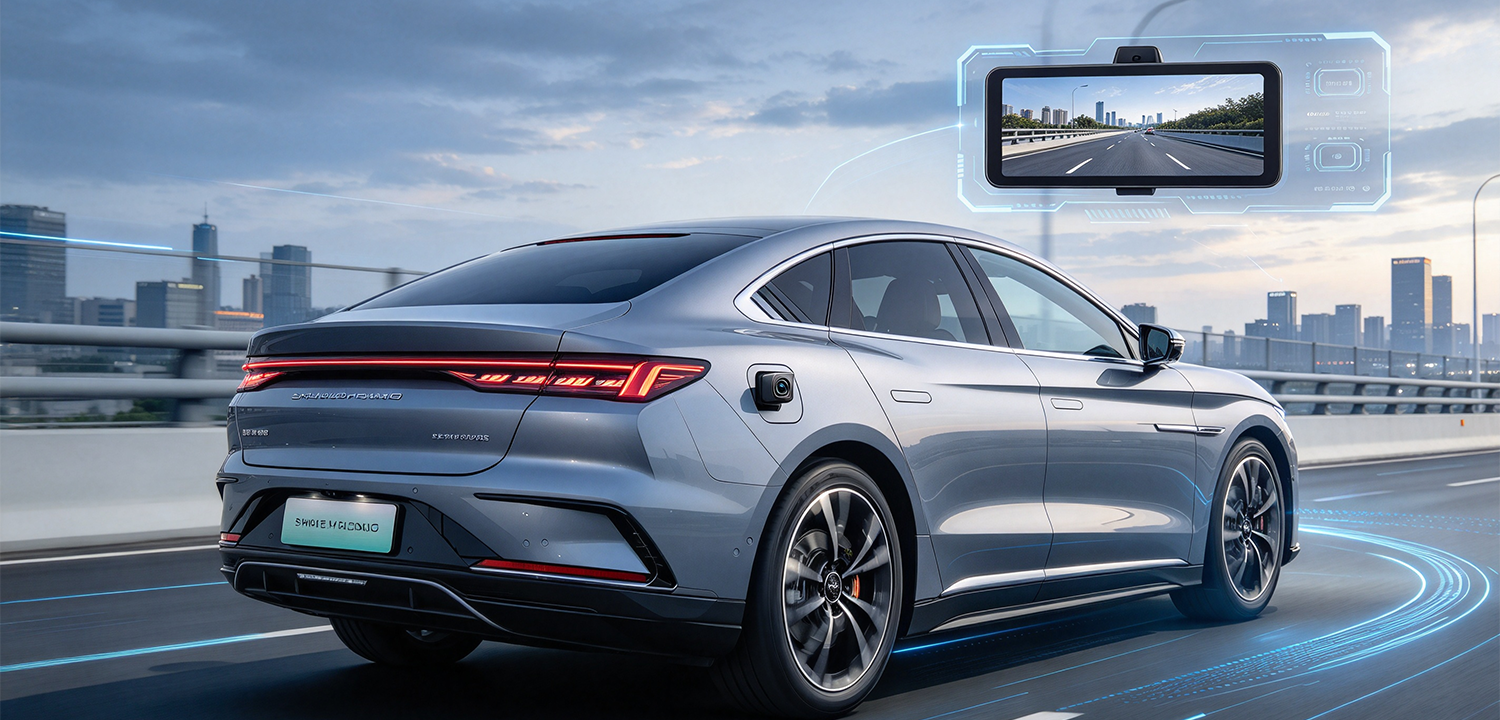
Driving safety has always been one of the core concerns of the automotive industry, and the rearview mirror system, as an important device for drivers to obtain the surrounding vision information of the vehicle, directly affects driving safety. Traditional optical rearview mirrors have natural limitations such as small field of view, blind spots, and easy to be affected by light and weather, which can no longer fully meet the needs of modern driving safety.
In recent years, with the maturity of image sensor, display and image processing technologies, streaming interior rearview mirrors and Camera Monitor System (CMS, also known as electronic exterior mirrors) have developed rapidly. By replacing or assisting traditional optical mirrors with cameras and displays, they can provide drivers with a wider, clearer and more intelligent field of vision, effectively reducing driving blind spots and improving driving safety.
This article will comprehensively analyze the development status, core technical indicators, functional value, regulatory trends and market prospects of streaming rearview mirrors and CMS electronic exterior mirrors, and deeply discuss the key factors that need to be paid attention to in the selection and application of such products, so as to provide professional reference for global OEMs, Tier 1 suppliers and industry practitioners.
Since the birth of automobiles, optical rearview mirrors have been used as standard configuration, helping drivers observe the situation behind and beside the vehicle. However, with the development of automobile technology and the increasing complexity of road traffic, the defects of traditional optical rearview mirrors have become increasingly prominent.
First, there are large blind spots. Due to the limitation of the size and installation position of the reflector, the field of view of the traditional rearview mirror is limited, and there are large blind spots on both sides and rear of the vehicle. When changing lanes, overtaking or reversing, it is easy to cause traffic accidents because the driver cannot observe vehicles or obstacles in the blind spot.
Second, it is greatly affected by light and weather. At night, in rainy and foggy days, or when the rear vehicle lights are dazzling, the reflection effect of the optical rearview mirror will be greatly reduced, the image is blurred or even dazzling, which seriously affects the driver's observation. Especially when driving at night, the strong light of the rear vehicle directly shines into the driver's eyes through the rearview mirror, which is easy to cause visual fatigue and even short-term blindness, bringing great safety hazards.
Third, it increases wind resistance and noise. The exterior rearview mirror protrudes from the body, which will increase the wind resistance coefficient of the vehicle, affect the power performance and fuel consumption of the vehicle, and also produce certain wind noise during high-speed driving, affecting the quietness of the vehicle. For electric vehicles, reducing wind resistance is of great significance for improving endurance.
Fourth, the interior rearview mirror is easily blocked. The interior rearview mirror is easily blocked by rear passengers, headrests, items in the trunk, etc., resulting in the driver being unable to see the situation behind the vehicle clearly, which affects driving safety.
The development of automotive electronic vision systems has gone through a process from interior to exterior, from simple streaming to intelligent assistance.
Streaming interior rearview mirror is the first product to be popularized. It replaces the traditional interior mirror reflector with a display screen, and transmits the picture taken by the rear camera to the display screen in real time, so that the driver can see the situation behind the vehicle through the screen, which is not blocked by the interior of the vehicle. At the same time, it has the advantages of anti-glare and clear night vision, and the cost is relatively moderate, so it is the first to be popularized in passenger cars.
On the basis of streaming display, functions such as driving recorder, parking monitoring and ADAS driving assistance have been gradually added, making the interior rearview mirror from a simple observation device to an intelligent safety device.
Further, the Camera Monitor System (CMS), which replaces the exterior rearview mirrors on both sides with cameras and displays, has also gradually moved from concept to mass production. CMS can completely eliminate the blind spots of exterior mirrors, reduce wind resistance, and have better performance in bad weather and at night. With the gradual opening of regulations in various countries, CMS has begun to be equipped in mass production models.
The global automotive intelligent rearview mirror and CMS market is growing rapidly. Driven by multiple factors such as the continuous improvement of people's attention to driving safety, the maturity of related technologies and the gradual opening of regulations, the assembly rate of streaming rearview mirrors and CMS products is increasing year by year.
In the Chinese market, streaming interior rearview mirrors have been widely used in independent brand models, and the penetration rate in SUVs and medium and high-end cars is relatively high. In overseas markets, especially in Europe, Japan and other regions, the research and application of CMS electronic exterior mirrors are at the forefront, and many luxury brands have launched mass production models equipped with CMS.
The main driving forces for market growth include the following aspects: First, safety demand is the core driving force. People pay more and more attention to driving safety, and the vision safety products that can effectively reduce blind spots and improve driving safety are more and more recognized by consumers and vehicle enterprises. Second, technological progress reduces costs. With the maturity of image sensors, display screens, processing chips and other technologies, the cost of streaming rearview mirrors and CMS products continues to decrease, making it possible to popularize from high-end models to mid-range models. Third, regulations are gradually liberalized. Countries around the world are successively revising relevant regulations to allow the use of camera monitoring systems to replace traditional rearview mirrors, which clears the legal obstacles for the large-scale application of CMS products. Fourth, the development of new energy vehicles has promoted industrial upgrading. New energy vehicle brands pay more attention to technological innovation and endurance performance, and CMS products have great attraction for new energy vehicles because they can reduce wind resistance and improve endurance, while having a sense of science and technology.
Streaming interior rearview mirror is currently the most mature and widely used product in automotive electronic vision systems, and it is also the first choice for most vehicle brands to upgrade their vision safety configuration.
Compared with traditional interior rearview mirrors, streaming interior rearview mirrors have obvious advantages in vision, safety and functionality.
First, unobstructed wide field of view. The streaming rearview mirror uses the rear camera installed at the rear of the vehicle to collect images, which is not blocked by rear passengers, headrests and items in the car, and can always present a complete rear vision. At the same time, the viewing angle of the camera is wider than that of the traditional reflector, which can cover a wider range behind the vehicle and reduce the rear blind spot.
Second, anti-glare and clear night vision. The streaming rearview mirror adopts high-dynamic-range image sensor and anti-glare display screen, which can automatically adjust the brightness according to the ambient light. When the rear vehicle turns on the high beam at night, it will not cause dazzling, but can present a clear picture, which greatly improves the safety of night driving.
Third, integrate driving recording function. Most streaming rearview mirrors integrate front and rear dual-channel driving recording functions, which can record the driving picture in real time, and can be used as evidence in case of traffic accidents, protecting the rights and interests of car owners. Some products also support parking monitoring function. When the vehicle is parked, if it encounters vibration or collision, it will automatically start recording, which plays a role in guarding the vehicle.
Fourth, expand ADAS driving assistance functions. Through the built-in image recognition algorithm, the streaming rearview mirror can realize ADAS functions such as lane departure warning (LDW), forward collision warning (FCW) and pedestrian detection (PD), and actively remind the driver of potential dangers during driving, further improving driving safety.
The effect of streaming rearview mirrors is closely related to hardware configuration. A high-quality streaming rearview mirror needs to be carefully configured in terms of camera, display screen, main control chip, etc.
In terms of cameras, front and rear dual cameras have become the mainstream configuration. The front camera is mainly used for driving recording and forward ADAS functions, and the mainstream configuration ranges from 1080P to 4K resolution; the rear camera is the core of the streaming function, and the resolution is usually 1080P or above, with high frame rate and high dynamic range, ensuring clear and smooth pictures.
High-quality image sensors have important indicators such as high sensitivity, low noise and wide dynamic range, which can ensure clear imaging in low-light environments such as night and tunnels, and will not overexpose or underexpose in strong light environments. In addition, the lens also needs to have anti-fog, waterproof and other properties to adapt to the complex external environment.
In terms of display screen, the size is usually 9.2 inches, 9.66 inches, 10.88 inches, 12.3 inches, etc. Larger screens can bring a wider field of view and better viewing experience. The display screen needs to have high brightness, high contrast and anti-glare treatment, ensuring that the picture is clearly visible under strong sunlight, and will not cause reflection glare to the driver.
In terms of main control chip, it needs to have strong image processing capability and operation capability, which can ensure the smooth operation of image acquisition, processing, display and ADAS algorithms, and the delay should be as low as possible. The delay of streaming rearview mirrors is a key indicator. If the delay is too high, the picture seen by the driver will lag behind the actual situation, which will affect driving safety.
Streaming interior rearview mirrors have strong adaptability and can be applied to various types of vehicles such as sedans, SUVs, MPVs and commercial vehicles.
For SUV and MPV models, because the body is tall and the rear window is small, the traditional interior rearview mirror has a worse field of view and is more likely to be blocked. The advantage of streaming rearview mirrors is more obvious, so the assembly rate is also higher.
For commercial vehicles such as light trucks and pickup trucks, the rear cargo box often blocks the interior rearview mirror, making the traditional interior mirror almost useless. The streaming rearview mirror can well solve this problem, allowing the driver to clearly observe the situation behind the cargo box, which is of great help to improve driving safety and reversing convenience.
At present, streaming rearview mirrors have gradually expanded from high-end models to mid-range and even entry-level models, and have become an important safety configuration for more and more models.
If the streaming interior rearview mirror is an upgrade of the traditional interior mirror, then the CMS electronic exterior mirror is a subversive replacement of the traditional exterior rearview mirror, which represents the future development direction of automotive vision systems.
Compared with traditional optical exterior mirrors, CMS systems have revolutionary advantages in safety, aerodynamics and intelligence.
First, eliminate blind spots and widen the field of view. The shooting angle of the camera is much wider than that of the traditional reflector, which can cover the area that the traditional rearview mirror cannot see, greatly reducing or even eliminating the side blind spot. When changing lanes and overtaking, the driver can more fully grasp the situation of the vehicles behind and on the side, reducing the occurrence of scraping accidents.
Second, reduce wind resistance and improve endurance. The camera assembly of CMS is much smaller than the traditional exterior rearview mirror, which can significantly reduce the wind resistance coefficient of the vehicle. For fuel vehicles, it can reduce fuel consumption; for electric vehicles, it can effectively improve the cruising range, which is of great practical significance.
Third, excellent night and bad weather performance. The camera has high dynamic range and low-light imaging capability, and with image enhancement algorithm, it can provide clearer side vision at night and in rainy and foggy days, which is far better than the traditional rearview mirror. At the same time, there is no dazzling problem of strong light from rear vehicles.
Fourth, intelligent superposition and auxiliary reminder. The CMS system can superimpose auxiliary lines, distance markers, blind spot warning and other information on the display picture, so that the driver can more intuitively judge the distance and danger, and further improve the safety of lane change and overtaking.
Although CMS has many advantages, its technical difficulty is also much higher than that of streaming interior rearview mirrors, and it needs to break through many technical challenges.
First, ultra-low delay requirement. For exterior rearview mirrors, the delay requirement is extremely high. If the picture delay is too high, the driver's judgment of distance and speed will be deviated, which is very dangerous when driving at high speed. At present, the delay of mainstream CMS solutions is usually controlled within 50 milliseconds, and even lower in high-end solutions, which requires high performance of image sensors, transmission links, processing chips and display screens.
Second, image quality and adaptive ability. The CMS system needs to maintain clear and stable imaging in various complex environments such as strong light, backlight, night, rain and fog, and tunnels. This requires not only high-quality image sensors, but also powerful image processing algorithms, including automatic exposure, white balance, noise reduction, wide dynamic processing, etc.
Third, display effect and ergonomics. The display screen of CMS is usually installed on both sides of the dashboard or inside the A-pillar. The position, size, brightness and viewing angle of the display screen need to be carefully designed to conform to the driver's viewing habits and ergonomics, so that the driver can quickly and naturally observe the picture, and will not cause visual fatigue after long-term use.
Fourth, reliability and safety redundancy. As a safety-related part, the CMS system must have extremely high reliability. In case of camera failure, system crash and other problems, there must be a corresponding safety mechanism to ensure that the driver can still obtain effective vision information. At the same time, the system also needs to meet the vehicle-level reliability standards and adapt to various harsh working environments.
The large-scale application of CMS is inseparable from the support of regulations. In the past, regulations in most countries required vehicles to be equipped with optical exterior rearview mirrors, which restricted the popularization of CMS.
In recent years, countries around the world have successively revised relevant regulations. The European Union, Japan, South Korea and other regions have successively allowed the use of camera monitoring systems to replace traditional exterior rearview mirrors, which has promoted the mass production and application of CMS products. Many luxury brands and new energy vehicle brands have launched mass production models equipped with CMS in these markets.
In China, relevant standards and regulations are also being gradually improved, and the pace of CMS liberalization is accelerating. With the further improvement of regulations, the Chinese market will also usher in a period of rapid development of CMS.
At present, CMS is mainly used in high-end new energy models and luxury brand models. With the reduction of cost and the liberalization of regulations, it will gradually sink to mid-range models, and the market prospect is very broad.
For streaming rearview mirrors and CMS products, the quality of products can be measured from the following core technical indicators. These indicators are also the key points that vehicle enterprises should focus on when selecting suppliers.
Image delay is one of the most critical safety indicators of automotive vision systems. It refers to the time difference from the scene in front of the camera to the final display on the screen. The lower the delay, the more real-time the picture, and the safer it is for driving.
For interior streaming rearview mirrors, the delay should be controlled within 100 milliseconds as far as possible; for CMS exterior mirror systems with higher safety requirements, the delay should be controlled within 50 milliseconds or even lower to ensure that the driver can make accurate judgments when driving at high speed.
Low delay requires optimization of the entire link, including camera acquisition, signal transmission, chip processing, screen display and other links. Any link with high delay will affect the overall effect. Suppliers with strong technical strength will carry out targeted optimization of the entire link to achieve ultra-low delay output.
Image quality directly affects the driver's visual experience and judgment accuracy. Excellent image quality requires clear picture, true color, natural transition of light and dark, and no obvious noise and smear.
Wide dynamic range (WDR/HDR) is a very important indicator. In the backlight environment, such as when the sun is directly behind or the rear vehicle lights are on at night, the system should ensure that both bright and dark areas are clearly visible, and there will be no overexposure of bright areas or too dark dark areas.
In low-light environments such as night and tunnels, the system should have good low-light imaging capability, with low noise and clear picture details, so that the driver can still clearly observe the surrounding vehicles and obstacles.
Automotive vision products work in the outdoor environment for a long time, and need to adapt to drastic changes in ambient temperature. Cameras installed outside the vehicle need to withstand high temperature in summer and severe cold in winter, and can work normally in the temperature range of minus 40 degrees Celsius to 85 degrees Celsius or even wider.
In addition, they also need to have the ability of waterproof, dustproof, anti-fog and anti-vibration, and can operate stably in rainy days, dusty, bumpy roads and other environments. The protection level of the camera part usually needs to reach IP67 or above to adapt to various harsh weather and road conditions.
For display screens installed in the car, they also need to adapt to the high and low temperature environment in the car, and will not have problems such as abnormal display and slow response due to temperature changes.
As automotive safety parts, streaming rearview mirrors and CMS products need to have a long service life and high reliability, and can work stably during the entire service life of the vehicle.
This requires that all components of the product adopt vehicle-grade specifications, and the design life meets the requirements of vehicle use. At the same time, strict reliability tests are required before mass production, including high and low temperature cycle test, temperature shock test, vibration test, salt spray test, electrostatic test, etc., to ensure that the product can withstand various harsh tests.
The combination of vision system and ADAS driving assistance function is an important development trend. On the basis of providing basic vision, more and more products integrate intelligent driving assistance functions to further improve driving safety.
At present, the common ADAS functions integrated in streaming rearview mirrors and CMS systems mainly include the following:
Lane Departure Warning (LDW): By identifying lane lines, the system monitors whether the vehicle deviates from the lane during driving. If the vehicle deviates from the lane without turning on the turn signal, the system will give an audible and visual reminder to prevent the driver from driving out of the lane due to fatigue or distraction.
Forward Collision Warning (FCW): By identifying the vehicle ahead, the system calculates the distance and relative speed with the vehicle ahead. If the distance is too close and there is a risk of collision, the system will give an early warning to remind the driver to brake and avoid rear-end collision.
Blind Spot Detection (BSD): Mainly used in CMS systems and high-end streaming rearview mirrors, by monitoring the blind area on the side and rear of the vehicle, when there is a vehicle in the blind area, the system will remind the driver through the indicator light or screen prompt to avoid dangerous lane change.
Pedestrian Detection (PD): Identify pedestrians on the road ahead or on the side, and give an early warning when there is a risk of collision, which is of great help to improve safety in urban road driving.
Door Opening Warning: When the vehicle stops and the passenger prepares to open the door, if there is a vehicle or non-motor vehicle approaching from behind, the system will give a reminder to avoid the "door opening accident".
The realization of these ADAS functions depends on powerful image recognition algorithms and software processing capabilities. Suppliers with independent algorithm research and development capabilities can continuously optimize and iterate the algorithm according to different use scenarios and regional traffic characteristics, improving the accuracy and stability of recognition.
At the same time, they can also customize and develop special functions according to customer needs, such as special detection functions for specific scenarios, to help customers build differentiated competitive advantages.
With the continuous improvement of chip computing power, more and more AI algorithms are applied to vehicle vision systems, making the recognition accuracy higher and higher, and more and more functions can be realized. In the future, vision systems will become more and more intelligent, from simple auxiliary display to active safety early warning, and then to auxiliary control, playing an increasingly important role in the field of intelligent driving.
As automotive safety-related products, streaming rearview mirrors and CMS systems have very strict requirements for quality and reliability. A perfect quality control system and sufficient reliability verification are essential.
The quality of components is the basis of product quality. High-quality automotive vision products will give priority to vehicle-grade components that meet AEC-Q standards, especially key components such as image sensors, main control chips and display screens, which must meet the requirements of wide temperature range and high reliability.
In the design stage, it is necessary to fully consider various working scenarios and failure modes, carry out sufficient thermal design, electromagnetic compatibility design, mechanical structure design, etc., to ensure that the product has good reliability and stability from the source of design.
At the same time, FMEA failure mode and impact analysis should be carried out to identify potential risks in advance and formulate corresponding preventive measures and countermeasures.
Before mass production, products need to undergo a series of strict reliability tests to simulate various harsh environments that may be encountered during actual use.
Common test items include:
High and low temperature test: Verify the working performance and storage performance of the product under extreme high temperature and low temperature conditions.
Temperature shock test: Verify the reliability of the product under rapid temperature changes, simulating the scene of the vehicle entering and leaving the temperature difference environment.
Vibration test: Simulate the vibration during vehicle driving to verify the structural firmness and working stability of the product.

This website uses cookies to ensure you get the best experience on our website.


 WhatsApp
 Phone
 E-mail
 Message
Comment
(0)